
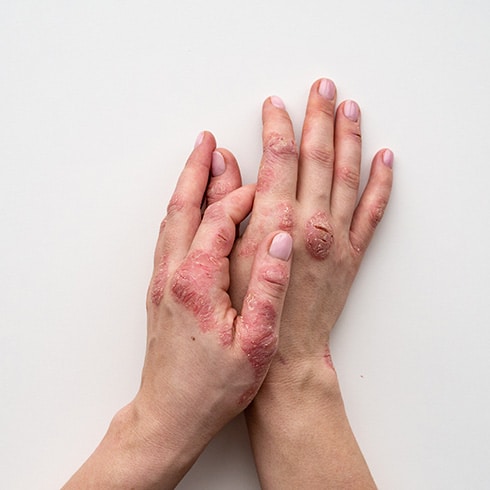
Psoriasis is a chronic autoimmune skin disease that causes red, bumpy patches covered with silvery-white scales. These patches are known as psoriasis lesions, which typically appear as well-defined, raised areas with scaly skin.. As a skin disease, psoriasis can significantly impact quality of life. The disorder is usually diagnosed based on its characteristic clinical features, and in some cases, a skin biopsy may be performed to confirm the diagnosis.
What is Psoriasis?
Psoriasis is a disorder of the skin that causes the skin cells to multiply up to 10 times faster than normal. This can cause the skin to build up, causing red, bumpy patches covered with white scales. These patches can appear anywhere but are most commonly found on the scalp, elbows, knees, and lower back. This condition usually appears in adulthood. Chronic psoriasis refers to the persistent, long-lasting nature of the disease, while chronic stationary psoriasis (psoriasis vulgaris) is the most common type, characterized by stable, persistent plaques that do not significantly change over time.
Symptoms of psoriasis may include:
- Plaques of red skin covered with silver scales. These may be itchy and painful.
- Disorders of the fingernails and toenails. This may include pitting and discoloration of the nails.
- Plaques or scales on the scalp.
While the exact cause of psoriasis is not yet known, it may be caused by a problem with the immune system which causes inflammation.
Psoriasis often runs in families but may skip generations. Risk factors for psoriasis include genetic predisposition, certain lifestyle choices, and systemic inflammation. People with psoriasis may be at an increased risk for developing metabolic syndrome, heart disease, cardiovascular disease, and kidney disease, making comprehensive management of these comorbidities essential.
Types of Psoriasis
Psoriasis is a chronic skin condition that can appear in several different forms, each with its own set of symptoms and patterns. Understanding the various types of psoriasis can help patients and their healthcare providers choose the most effective psoriasis treatment and manage symptoms more effectively. The main types include:
Plaque Psoriasis: This is the most common form, known medically as psoriasis vulgaris or chronic plaque psoriasis. It typically causes raised, red patches covered with a silvery-white buildup of dead skin cells, called psoriasis plaques. These lesions often develop on the scalp, elbows, knees, and lower back, and can be itchy or painful. Severe plaque psoriasis may cover large areas of the body and significantly impact quality of life.
Guttate Psoriasis: Guttate psoriasis often appears suddenly, usually after an upper respiratory tract infection. It is characterized by small, drop-shaped spots on the skin, most commonly affecting the trunk, arms, and legs. This type is more common in children and young adults and may resolve on its own or develop into chronic plaque psoriasis.
Pustular Psoriasis: Pustular psoriasis presents as white pustules (blisters of noninfectious pus) surrounded by red skin. It can be localized to certain areas, such as the hands and feet, or become generalized pustular psoriasis, which affects larger areas of the body and typically involves painful inflammation. This severe form may require urgent medical attention.
Erythrodermic Psoriasis: Erythrodermic psoriasis is a rare but serious type that causes widespread redness and shedding of the skin in large sheets. This form can cover most of the body and is often accompanied by severe itching, pain, and changes in body temperature. Erythrodermic psoriasis is considered a medical emergency and can be life-threatening if not treated promptly.
Inverse Psoriasis (Flexural Psoriasis): Inverse psoriasis, also known as flexural psoriasis, affects skin folds such as the armpits, groin, under the breasts, and around the genitals. It appears as smooth, red patches and is more likely to cause irritation due to friction and sweating in these areas.
Each type of psoriasis can vary in severity and may require different approaches to management. If you notice changes in your skin that resemble any of these forms, consult a dermatologist for an accurate diagnosis and personalized treatment plan.
Psoriasis Treatment Options
There are many different treatment options that can be used to treat the symptoms of psoriasis for a more comfortable daily routine. Some of the popular ones include:
Topical Therapy
Corticosteroids
These medications are the most popular treatment option for mild to moderate psoriasis. They are available as ointments, lotions, creams, gels, foams, shampoos, and sprays. It is not recommended that corticosteroids be used long-term, as they may cause thinning of the skin.
Retinoids
Tazarotene, a type of retinoid, is available as a cream or gel and is usually applied 1-2 times daily. Retinoids are not recommended for pregnant or breastfeeding women or if you intend on becoming pregnant.
Calcineurin Inhibitors
These medications are used to reduce inflammation and buildup of plaque. They are not recommended for those who are pregnant, breastfeeding or intend on becoming pregnant. It is also not intended for long-term use as it may increase your risk for skin cancer.
Vitamin D Analogues
Synthetic forms of vitamin D can slow skin cell growth. These drugs may be used alone or with topical corticosteroids.
Light Therapy
- Sunlight: Daily, brief exposure to sunlight may improve psoriasis symptoms. It is important that you ask your doctor the safest ways to use natural light for treatment.
- UVB broadband: Regulated amounts of UVB broadband light from an artificial light source may be used to treat psoriasis that doesn’t improve with topical treatments.
- UVB narrowband: UVB narrowband light therapy can be administered 2-3 times weekly to improve psoriasis.
Oral or Injected Medications
- Steroids: An injection of triamcinolone may be recommended for small, stubborn patches of psoriasis.
- Retinoids: Retinoid pills can be used to reduce the production of skin cells. These drugs should not be used by those who are pregnant, breastfeeding, or intend to become pregnant. Conventional systemic therapy, such as methotrexate or cyclosporine, is also commonly used for moderate to severe psoriasis when topical treatments are insufficient.
- Biologics: Biologics are drugs that alter the immune system to disrupt the disease cycle and improve symptoms. They are usually administered by injection. Biologic therapy is a targeted treatment for severe cases, especially when conventional therapies fail, and works by blocking specific inflammatory pathways. Common biologics that have been approved to treat psoriasis include Enbrel, Humira, Stelara, Cosentyx, Skrizi, Tremfya, and Taltz.
- Systemic therapy is particularly indicated for unstable plaque psoriasis, as well as for severe forms such as pustular or erythrodermic psoriasis, which can present with widespread skin involvement and systemic symptoms.
Systemic therapy is particularly indicated for unstable plaque psoriasis, as well as for severe forms such as pustular or erythrodermic psoriasis, which can present with widespread skin involvement and systemic symptoms.
Psoriasis FAQs
Can I put steroid cream on psoriasis?
Can psoriasis kill you?
Is Psoriasis an autoimmune disease?
Can you spread psoriasis by touching it?
Do I have eczema or psoriasis?
Does hydrocortisone treat psoriasis?
Ideal Candidates for Psoriasis Treatment
If you have been diagnosed with psoriasis or believe that you may have psoriasis, it is important that you see a dermatologist such as Dr. Erwin to properly treat your symptoms. During your first appointment, Dr. Erwin will assess your skin and examine the skin tissue for characteristic changes, as well as speak with you regarding your symptoms to properly diagnose and treat your skin. If you are interested in scheduling an appointment, contact our office today!
Contact Us Today
If you are looking for relief from your psoriasis symptoms, do not hesitate to contact our office by calling 979-543-9933. We will be happy to assist you in scheduling your initial appointment!